

Our Centre of Excellence
Once the exceptional silk has been selected in Como, it continues its journey across the Mediterranean to Tunisia, to Mahdia, where it truly comes to life in the hands of our artisans. Here, the thread becomes fabric. To the rhythm of practised gestures and a craft handed down from generation to generation, our artisans weave far more than cloth: they weave our heritage. The cradle of our craftsmanship, Tunisia is where the nobility of silk meets the precision of the human hand, giving birth to pieces full of character and history.
This Tunisian coastal town, little known to the wider public, lies at the heart of Skila’s story. Its strategic location and its fortifications allowed the town, known successively as Jemma, Aphrodisium and Cap Africa, to play a leading role in the Mediterranean basin until the 16th century. Mahdia was first a Phoenician trading post, then a Punic settlement. Under Roman rule, it became Aphrodisium.
The year 916 saw the arrival of the first Fatimid caliph, Ubayd Allah al-Mahdi, who ordered the founding of Mahdia, whose construction spanned five years, and who gave the town its present name.
The town thus became the capital of the Fatimids in 921 and remained so until 973, when Mahdia was replaced by Cairo. Besieged for eight months (944–945) by the Kharijites under the command of their leader Abu Yazid, the town victoriously held out. In 1057, the Zirids took refuge there in the face of the Hilalian threat.
In 1086–1087, to put an end to the repeated attacks by the corsairs of this region, notably those orchestrated by the Zirid ruler Tamim (1062–1108), the great merchant cities of the northern Mediterranean — Genoa, Pisa, Amalfi, Salerno and Gaeta — fitted out ships and seized Mahdia. The attack, led by Hugh of Pisa, had the help of Rome; it also involved Lord Pantaleone of Amalfi and received the support of Matilda of Tuscany.
Although Mahdia was taken, the Italians did not manage to hold it. The money from the spoils was spent on Pisa Cathedral and on the construction of a new church. The Norman king Roger II of Sicily occupied it in 1148 and held his ground until the fall of the town, in the first days of 1160, to the Almohads. The town then lost its political importance to Tunis but nonetheless remained an important port. Over the course of its history, the town faced several Spanish, Vandal and Turkish sieges.
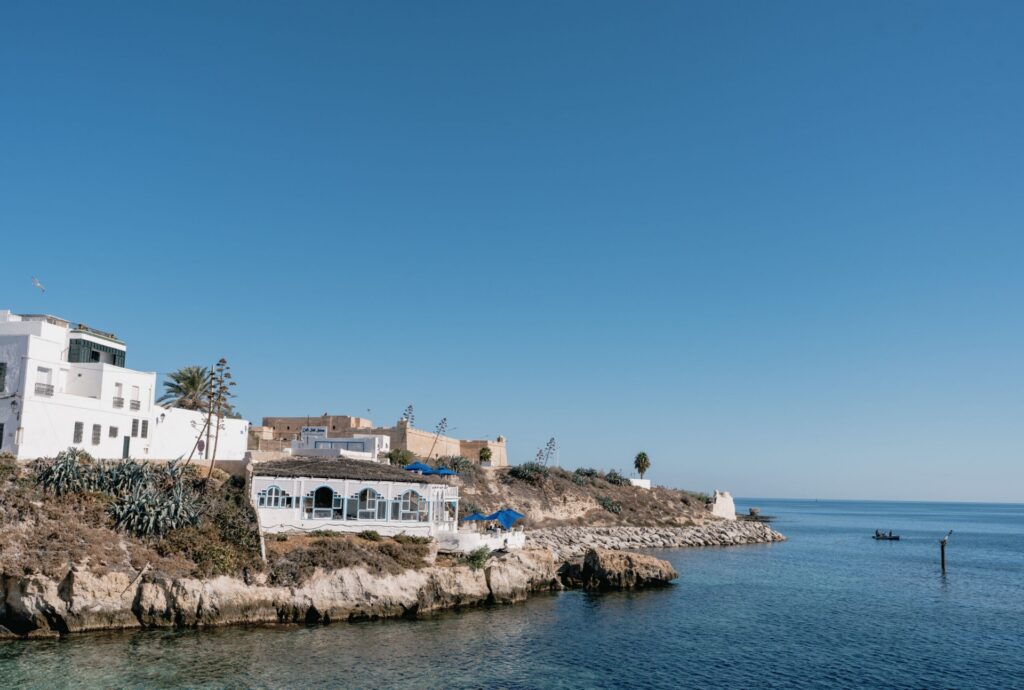
Mahdia — between stone and sea
The art of weaving
The art of weaving developed there from 916 under the Fatimids, influenced by their conquests in the Aghlabid kingdom, where the weaving of wool, linen and silk was already well established. Ceremonial garments were worn at the caliphs’ court for Friday prayers or celebrations.
The development of the textile industry was made possible by the gold trade, which fostered exchanges across Africa, and by the demand for luxury garments in capitals such as Mahdia and Sabra Al-Mansuriya, another Fatimid city located near Kairouan. Sericulture in Gabès and in the western Mediterranean area of southern Tunisia supplied the silk. For the caliphs, silks were a symbol of prestige and dignity, which also extended to the weaving of banners for armed conflicts, sheets, curtains and even coverings for Arabian thoroughbreds.
According to historical accounts, even funeral garments were richly made of silk and embroidery. The weaving workshops were divided between the Medina and the palaces, in « Dar el Tiraz » (weaving workshops) devoted solely to the needs of the sovereign. The caliph’s name had to appear on every piece, embroidered in gold thread. The weaver’s profession was therefore highly esteemed and entirely controlled by the highest representative of the State.
At the time, weaving was done on the draw loom, a wooden loom still in use in Mahdia today.
Thanks to its influence as the Fatimid capital of an empire stretching from Morocco to Syria, Mahdia attracted weavers from Syria, Yemen and Iraq alike.
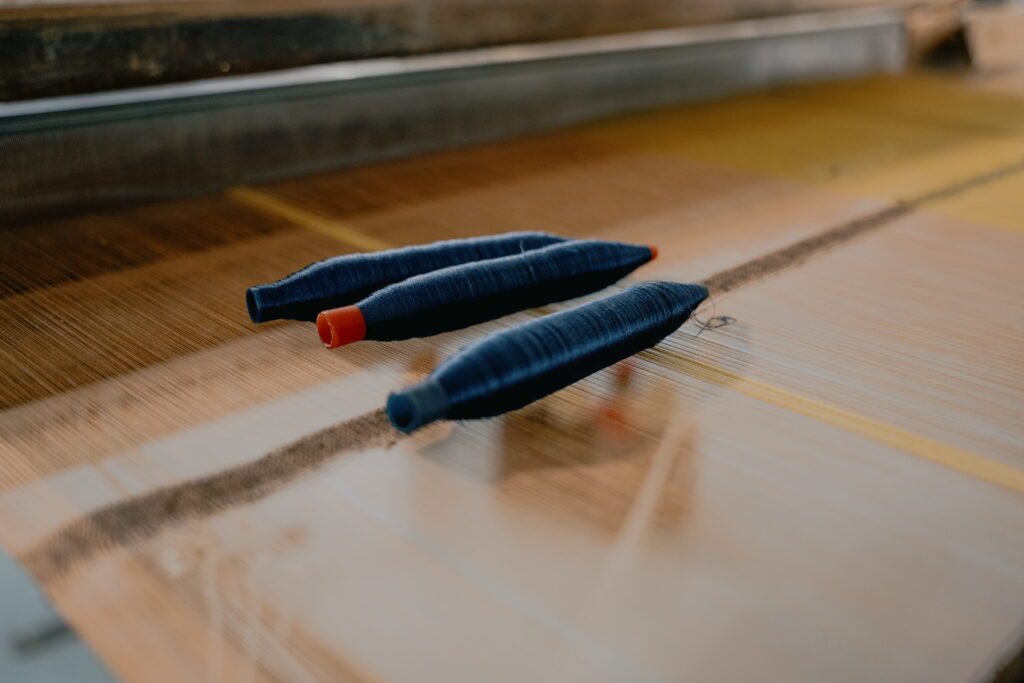
The gesture, suspended between sky and sea
After the invasion and partial destruction of Mahdia by Charles V in the 16th century, it took a Franco-Ottoman alliance between Francis I and Suleiman the Magnificent for silk to regain its standing in Mahdia. This agreement brought new influences into the weaving, further enriched by the arrival of the Andalusians in the 15th century, while the Jewish weaving families who had fled the destruction of the town took refuge in Tripolitania.
The traditional costume of Mahdia (Rdé) features motifs that evoke Berber culture as well as the town’s Carthaginian and Roman influences, along with Jewish and Islamic motifs. Since then, Mahdia weaving has become an art used in particular for the Mahdia wedding attire, one of the richest of all the regional costumes.